
Table of Contents
Typical monthly costs for private residential swimming pool maintenance in Singapore range from about S$150 to S$300 for professional service, with a wider market range of roughly S$80 to S$500 depending on pool size, frequency, and scope of work. Electricity for pump operation and water top‑ups are the main variable add‑ons, with the regulated household electricity tariff around 29.94 cents/kWh with GST in mid‑2025 and potable water priced at S$3.24 per m³ before GST from April 2025.
Cost snapshot
For a typical landed or penthouse pool under professional care, a realistic monthly service fee is commonly quoted between S$150 and S$300, while some providers state a broader S$80 to S$500 range based on pool size and service frequency. Some firms offer all‑in monthly packages that include cleaning, chemical balancing, and equipment checks, often clustered around a few hundred dollars for small residential pools. Utilities then layer on top, with electricity billed at the regulated tariff level set by the Energy Market Authority and water at PUB’s revised potable rates effective April 2025.
What drives costs
The biggest drivers are pool volume, filtration and circulation time, service frequency, and whether chemicals and minor consumables are bundled in the plan or billed separately. Scope of work also matters, as standard visits typically include skimming, brushing, vacuuming, chemical testing and balancing, and filter maintenance aligned to NEA expectations for safe water. In Singapore’s hot, humid, and rainy tropical climate, more frequent debris removal and vigilant sanitation are often needed to keep algae at bay, which can raise ongoing upkeep needs.
Monthly budget breakdown
- Service fees: S$150–S$300/month is a common range for small residential pools, with broader quotes from S$80 up to S$500 depending on size and frequency.
- Electricity: Cost equals pump power (kW) × run hours × tariff; the regulated tariff for June–September 2025 is 29.94 cents/kWh with GST, and many practitioners recommend extended daily circulation in the tropics to maintain clarity and sanitation.
- Water top‑ups and backwash: PUB’s domestic potable water price reaches S$3.24 per m³ before GST from April 2025, so each additional cubic metre of makeup water scales costs linearly.
- Chemicals and testing: Professional packages often include chemical balancing as part of the visit fee; DIY programs must budget for chlorine, pH reducer or increaser, and periodic shock oxidizer aligned to NEA’s safe ranges.
DIY vs professional care
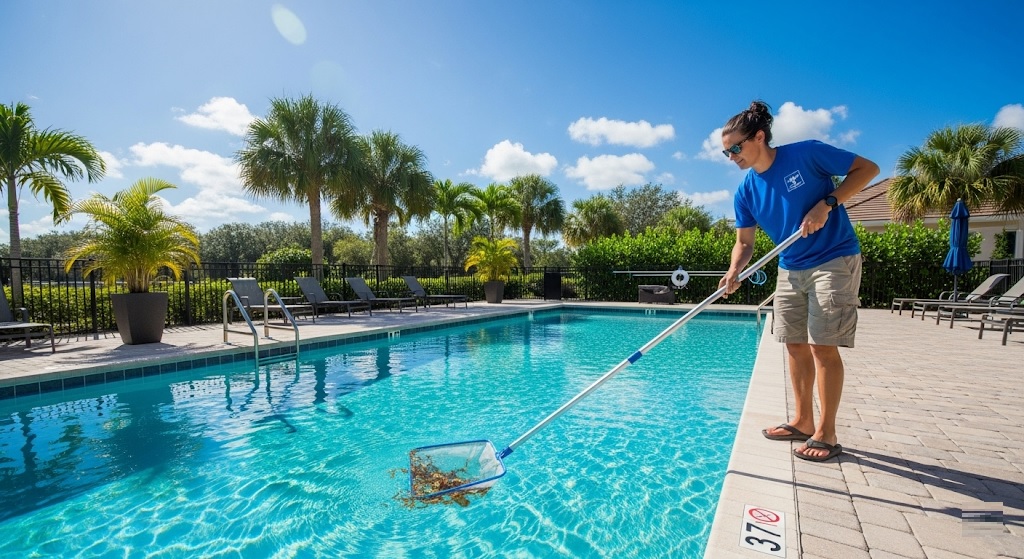
Professional operators typically handle routine skimming, debris removal, brushing, vacuuming, pump and filter checks, and water testing and balancing to keep pools safe and clear under NEA’s regulatory framework for aquatic facilities. DIY programs can reduce service fees but trade time, learning curve, and out‑of‑pocket spending on tools, test kits, and chemicals, which can add up over months. For many households, a monthly package that includes chemicals and inspection offers predictable costs and quality assurance, while DIY is more viable for owners willing to follow a strict regimen.
Chemicals and safe water balance
Singapore guidance highlights daily on‑site testing for pH and residual disinfectant for licensable aquatic facilities, reflecting the central role of correct water chemistry in swimmer safety and clarity. NEA‑aligned practice keeps pH roughly 7.2–7.8 and chlorine in the 1.0–3.0 ppm range, which ensures effective disinfection while minimizing irritation and corrosion risk when monitored consistently. Professional programs that include chemical balancing can help maintain these targets more consistently in a high‑use or high‑rainfall environment.
Electricity and pump runtime
Circulation is the backbone of water clarity, and many maintenance checklists for tropical conditions recommend long daily pump operation to ensure turnover, even chemical distribution, and algae control. Electricity cost planning uses a simple formula of kW × hours × tariff, with the household regulated tariff at 29.94 cents/kWh with GST in June–September 2025 providing a current price point for estimates. Extended pump runtime improves stability, but optimizing flow, basket cleaning, and filter condition can reduce wasted energy while preserving clarity.
Water use and refilling
Top‑ups after splash‑out, evaporation, and backwashing are billed at PUB’s potable water rates, which for domestic users reach a total S$3.24 per m³ before GST from April 2025, so budget estimates can scale by expected cubic metres of makeup water per month. A simple planning approach is to estimate expected backwash and weather‑related losses, then multiply by PUB’s posted price to forecast monthly water costs. Households can also review PUB’s announcements to anticipate any future price changes when planning annual budgets.
Tropical climate implications
Singapore’s climate is hot, wet, and humid year‑round, with heavier rainfall and frequent thunderstorms from November to January, conditions that accelerate debris accumulation and raise algae pressure without vigilant circulation and sanitation. Annual rainfall around 2,100–2,200 mm and near‑uniform high temperatures drive higher biological activity, making consistent brushing, filtration, and chlorine maintenance especially important. These climate features explain why missed service visits can rapidly degrade water quality and increase recovery costs.
Smart saving tips
- Improve circulation efficiency: Keep skimmer and pump baskets clear, set return jets correctly, and monitor filter pressure so the system moves water effectively without excessive run time.
- Prevent problems: Maintain NEA‑aligned chemistry and shock during heavy bather load or after storms to avoid algae blooms that require intensive recovery and extra chemicals.
- Cut water loss: Use a properly fitted cover during long idle periods to limit evaporation and debris, reducing makeup water and cleaning frequency under wet, windy conditions.
- Plan utilities: Use the regulated tariff as a baseline for electricity calculations and PUB’s posted price for water budgeting to avoid underestimating ongoing operating costs.
When to call a pro
Calling a licensed pool specialist is prudent when persistent cloudiness or algae resists normal shock and brushing, as this can signal filtration or sanitation gaps that require diagnostic testing and targeted remediation. Professional teams typically provide structured checklists for Singapore’s climate, including brushing, vacuuming, shock, and filter maintenance scheduled to prevent the cycle of recurring blooms. Providers with established packages often bundle chemical balancing and equipment checks, which can stabilize monthly costs and extend equipment life.
Working with Watercraft
A comprehensive maintenance partner can tailor visit frequency, chemistry management, and equipment inspections for local climate realities, providing predictable care plans built around Singapore’s regulatory and weather context. Service portfolios commonly span routine cleaning, water balancing, and reliability‑focused equipment care, helping owners sustain clarity and safety standards throughout the year. Clear communication on scope, inclusions, and emergency response helps align expectations and protects long‑term pool health.
Key takeaways
- Service fees for small residential pools often sit around S$150–S$300 per month, with market quotes ranging S$80–S$500 depending on size and frequency.
- Use kW × hours × tariff to price pump electricity, applying the regulated 29.94 cents/kWh with GST as a current benchmark for mid‑2025.
- Plan water top‑ups at PUB’s S$3.24 per m³ before GST from April 2025, scaling estimates by expected makeup volume.
- Maintain NEA‑aligned pH and chlorine levels to prevent algae and reduce recovery costs, especially in Singapore’s humid, rainy climate.
- Routine professional checklists adapted for tropical conditions can stabilize monthly costs by preventing problems before they escalate.
Strong budgeting starts with the three pillars of utilities, costs, and chemistry, backed by consistent swimming pool maintenance suited to Singapore’s climate and regulatory guidance for a resilient ownership budget.